Start with the widest thing that has to go through the gate, then choose the material, then make sure it hangs on posts that can carry it. Most farm gates that give trouble are not the wrong gate. They are a heavy gate on a hanging post that is too light or not set deep and solid enough, so the latch end drops, it drags, and someone ends up lifting it open every day.
1. Work out the width
Walk through everything that will use the gate, now and in a few years: the ute and trailer, the tractor with a slasher or spray unit, a header or contractor's machinery, a stock truck, a horse float. Measure the widest one and leave room to spare, because nobody threads machinery through a gate with a hand-span either side, least of all on a turn.
Off-the-shelf steel farm gates come in set lengths. For example, Clipex lists its mesh farm gates at 1.2 metres high in lengths from 4 to 14 feet (about 1.2 to 4.2 metres) (Clipex farm gates). If your opening falls between sizes, you either build the opening to suit the gate or have the gate made to fit the opening. Every gate Neil builds is made to the width of the opening, single or double.
Single or double?
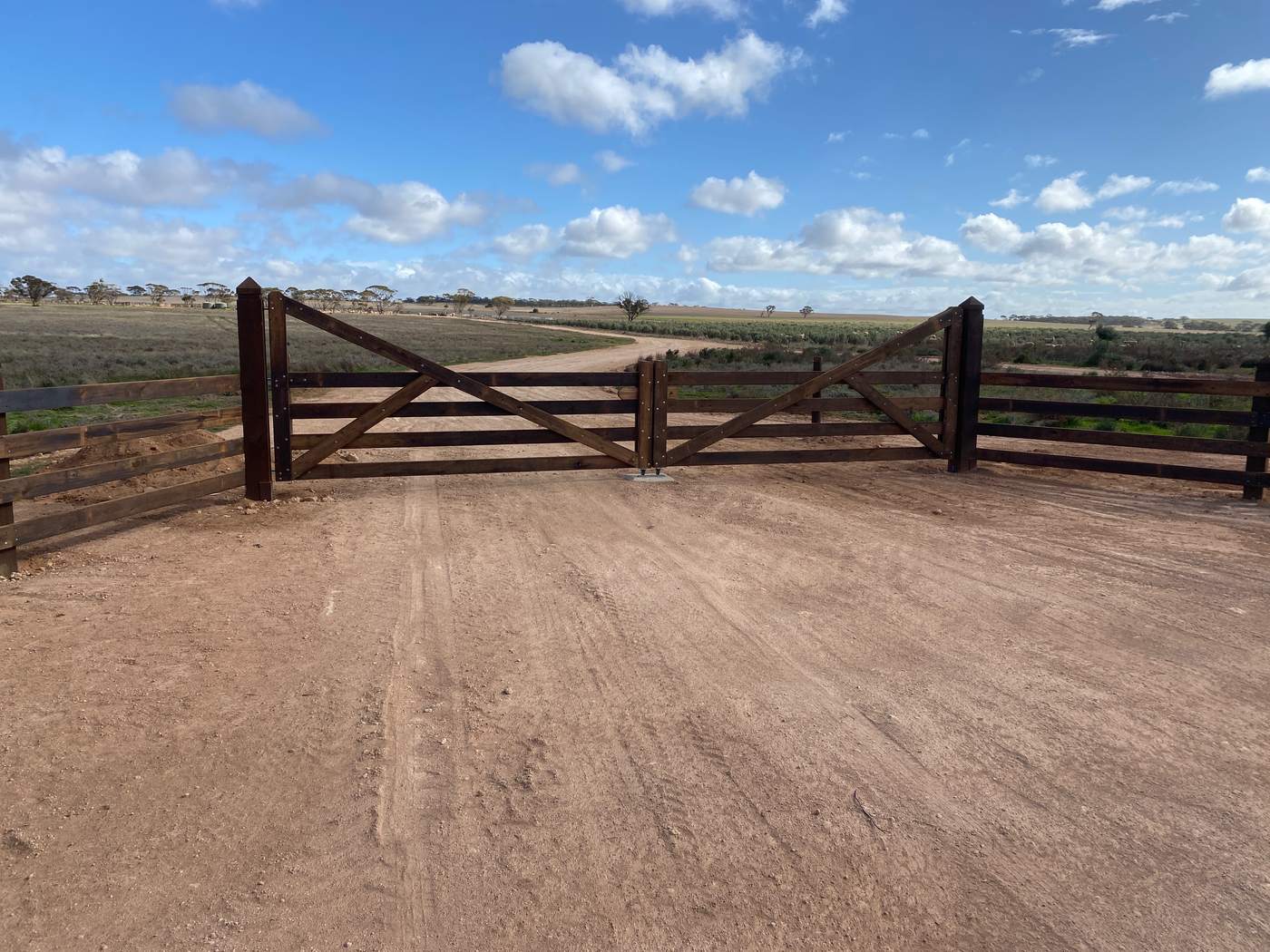
Past a certain width, a pair of gates is easier to live with than one long one. Each leaf is shorter and lighter, so there is less load on each hanging post and less swing room needed. A single gate is quicker to open on foot and only needs one good post and one latch post. Wide entrances and machinery openings often suit a pair. Laneway and yard gates often suit a single.
Check the swing
Look at the ground the gate will swing over. On a slope, a gate that opens uphill can hit the ground halfway, so it may need to open the other way or be hung higher. Decide which way it opens before the posts go in: think about where stock will be pushing, where you stop the ute, and where you stand to open it.
2. Choose the material
For farm gates the choice is mostly between timber and steel.
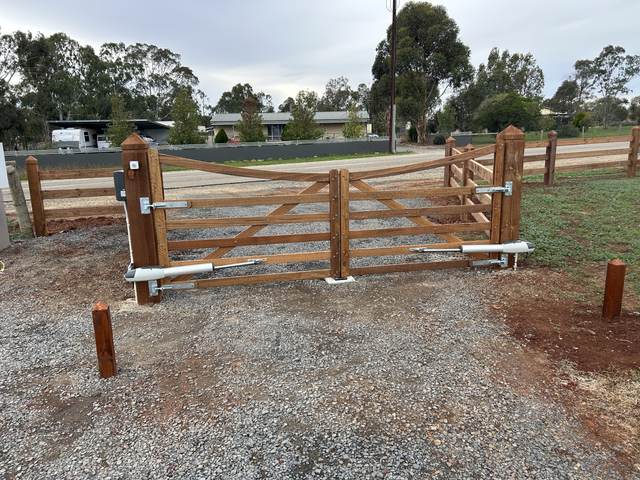
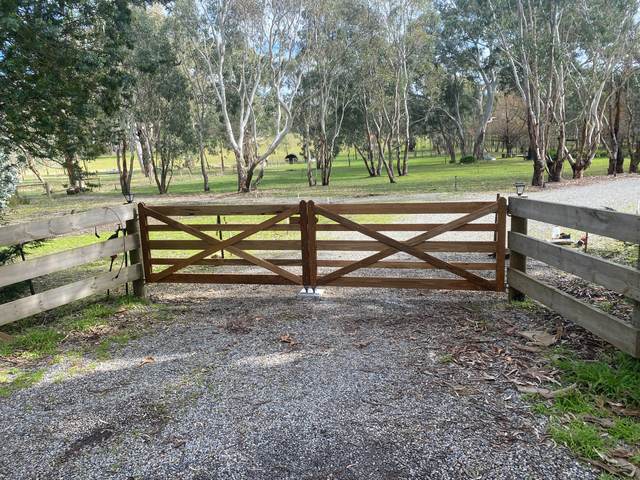
- Timber looks right on an entrance or along post and rail, and can be built to any width and design. It is heavier, so the posts and bracing matter more. Neil works mostly in hardwood, and spotted gum is his go-to.
- Steel mesh or tube gates are lighter for their width and suit paddocks and laneways where a gate takes knocks. Steel farm gates can be hot-dip galvanised so they hold up out in the paddock.
If stock includes lambs, calves or small animals that can push through rails, add mesh. Neil builds paddock post and rail with mesh where it is needed, and can build the gate and the post and rail on either side as one job so it all lines up.
3. Hang it properly
This is where most farm gate problems start. A gate is a long lever: all of its weight hangs off one post through two hinges, and every time it is opened, climbed on or pushed by stock, that post takes the load.
- The hanging post needs to be heavier than a line post and set deep and solid enough for the ground. Barossa and Hills ground can change from clay to rock within a few metres, so the footing has to suit the spot, not a rule of thumb.
- The brace in a timber gate should run from the bottom corner on the hinge side up to the top corner on the latch side. That way it pushes the latch end up instead of letting it drop.
- The hinges should suit the gate's weight, and adjustable hinges let you take up a little movement later.
- The latch should hold against stock pushing and be easy to work from horseback or from the ute window if that is how you use it.
Signs a gate is badly hung: the latch no longer lines up, the end drags or leaves an arc in the dirt, you have to lift it to close it, or the hanging post leans. Replacing the gate alone rarely fixes that. If yours is heading that way, send Neil a photo and he can tell you whether it needs a new gate, a new hanging post, or both.
4. Think about later
If there is any chance you will want the gate automated, say so before it is built. A gate set up for a motor from the start has the right posts, the right weight and room for the motor arm and control box. Long driveways and road gates often end up on a solar gate opener, so it is worth reading how solar gate openers work first. Also see gate automation.
Farm gates around the Barossa and the Hills
Neil builds farm and rural gates, entrance gates and driveway gates from his base in Angaston, for properties across the Barossa Valley, around Williamstown and Lyndoch, the Adelaide Hills and Gawler. He hangs every gate on site himself, or you can collect it or have it delivered ready to install. See custom gates and rural and farm fencing.
Common questions
What width farm gate do I need?
Measure the widest machine or vehicle that will use the gate and leave room to spare for turning. Off-the-shelf steel farm gates come in set lengths, such as 4 to 14 feet (about 1.2 to 4.2 metres) in the Clipex range. A made-to-measure gate is built to your opening instead.
Should I get a single or double farm gate?
A single gate is quicker to open on foot. For wide entrances and machinery openings, a pair is often better: each leaf is shorter and lighter, so the posts carry less load and the gates need less room to swing.
Why does my farm gate sag?
Usually the hanging post has moved or is too light for the gate, the brace runs the wrong way or is missing, or the hinges are worn. A new gate on the same post often sags again, so check the post first.
Timber or steel for a farm gate?
Timber suits entrances and matches post and rail; it is heavier, so posts and bracing matter more. Steel mesh or tube gates are lighter for their width and suit paddocks and laneways, and steel can be hot-dip galvanised.
Can a farm gate be automated later?
Yes, if it swings freely and the motor is rated for its length and weight. If you think you will want a motor, say so before the gate is built so the posts and gate are set up for it.
Want a price for your job? Call Neil on 0447 044 266 or send a photo through the quote form.