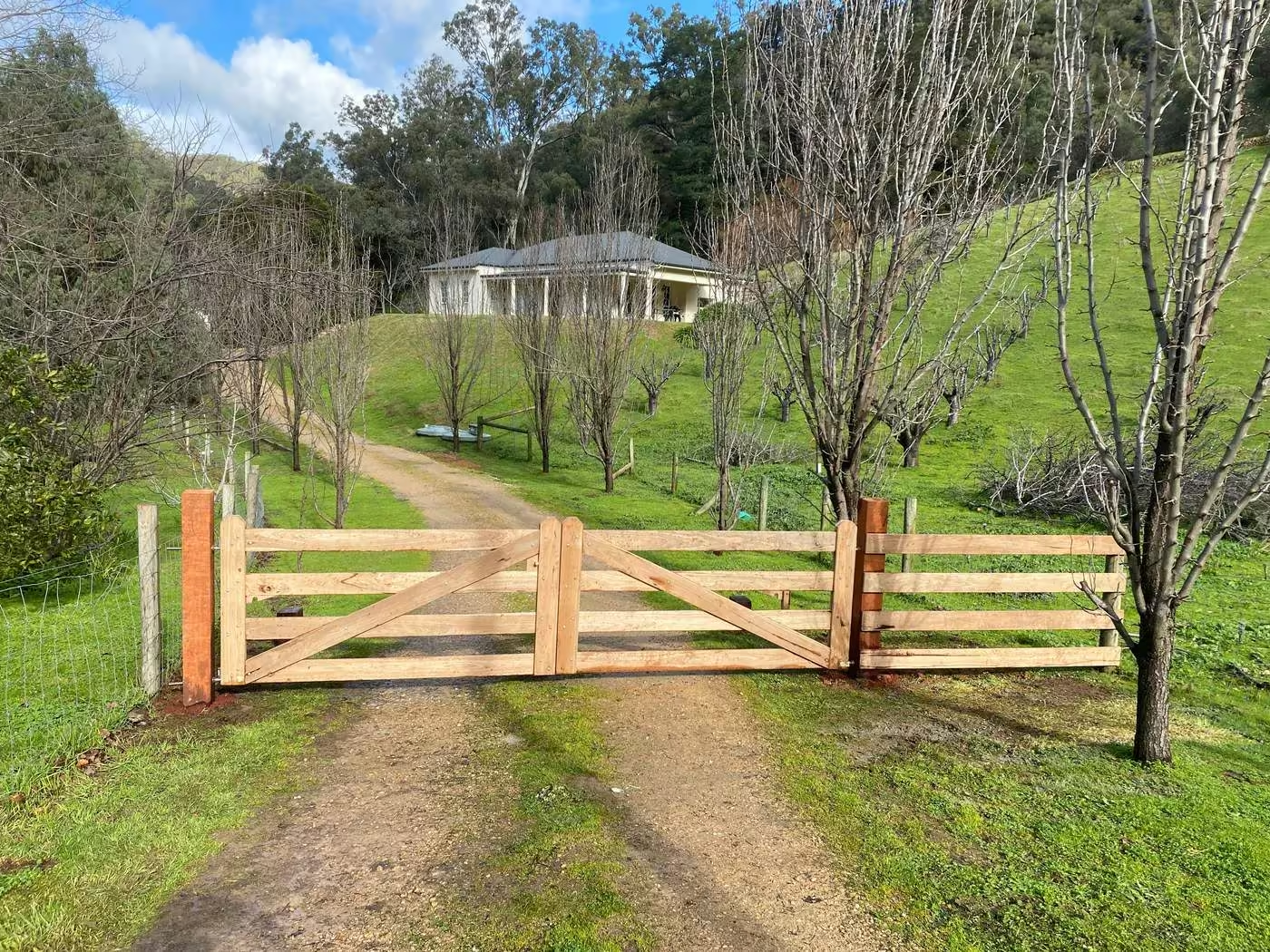
On most rural entrances a swing gate is the simpler choice: it needs no track, it suits a timber pair, and it is easy to hang so it stays square. A sliding gate makes sense when there is no room for the leaves to swing, when the driveway climbs straight after the gate, or when the gate sits close to the road and you need to pull right off before it opens. It needs a clear, fairly level run of fence beside the opening at least as long as the gate.
How each one works
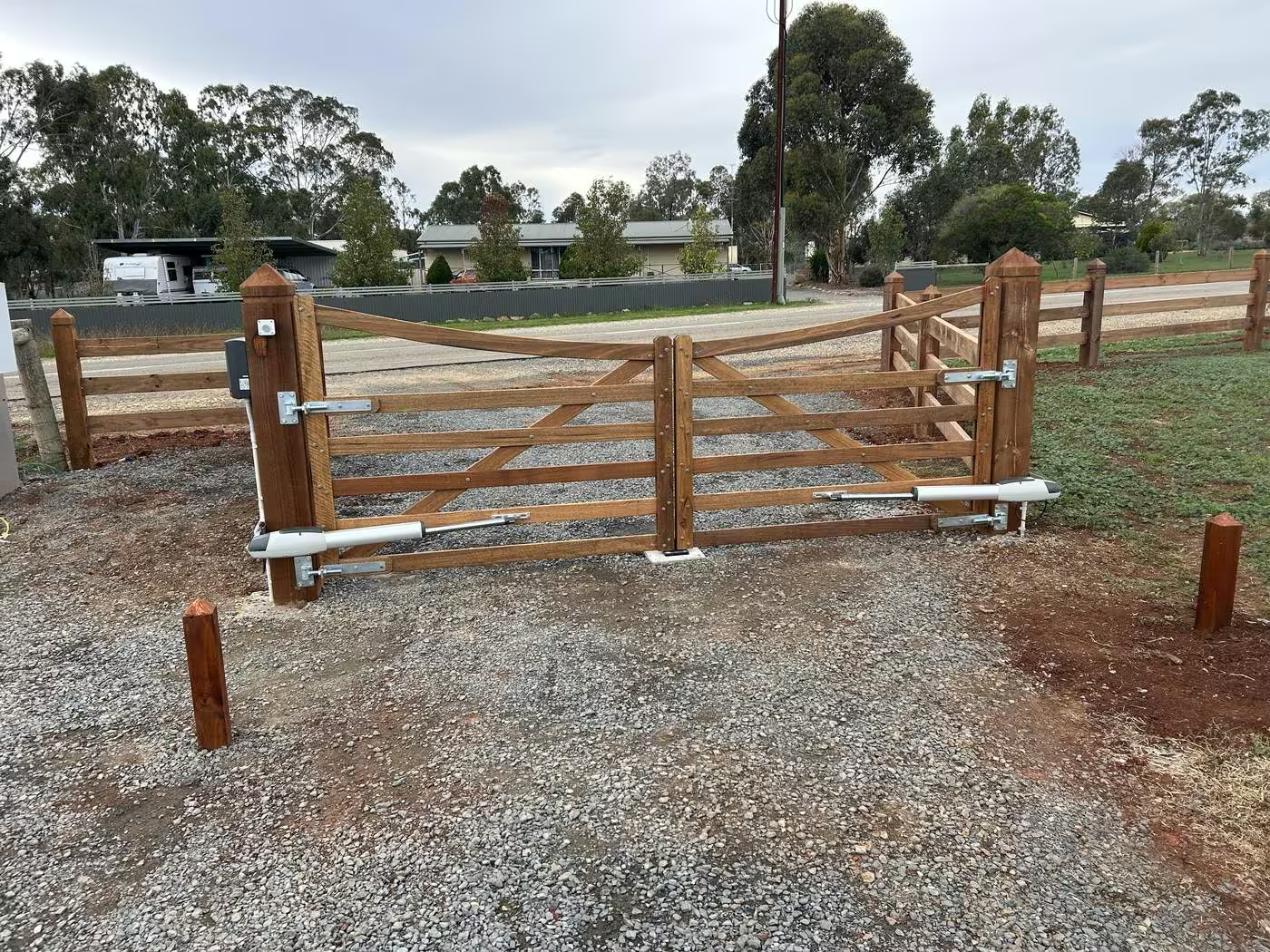
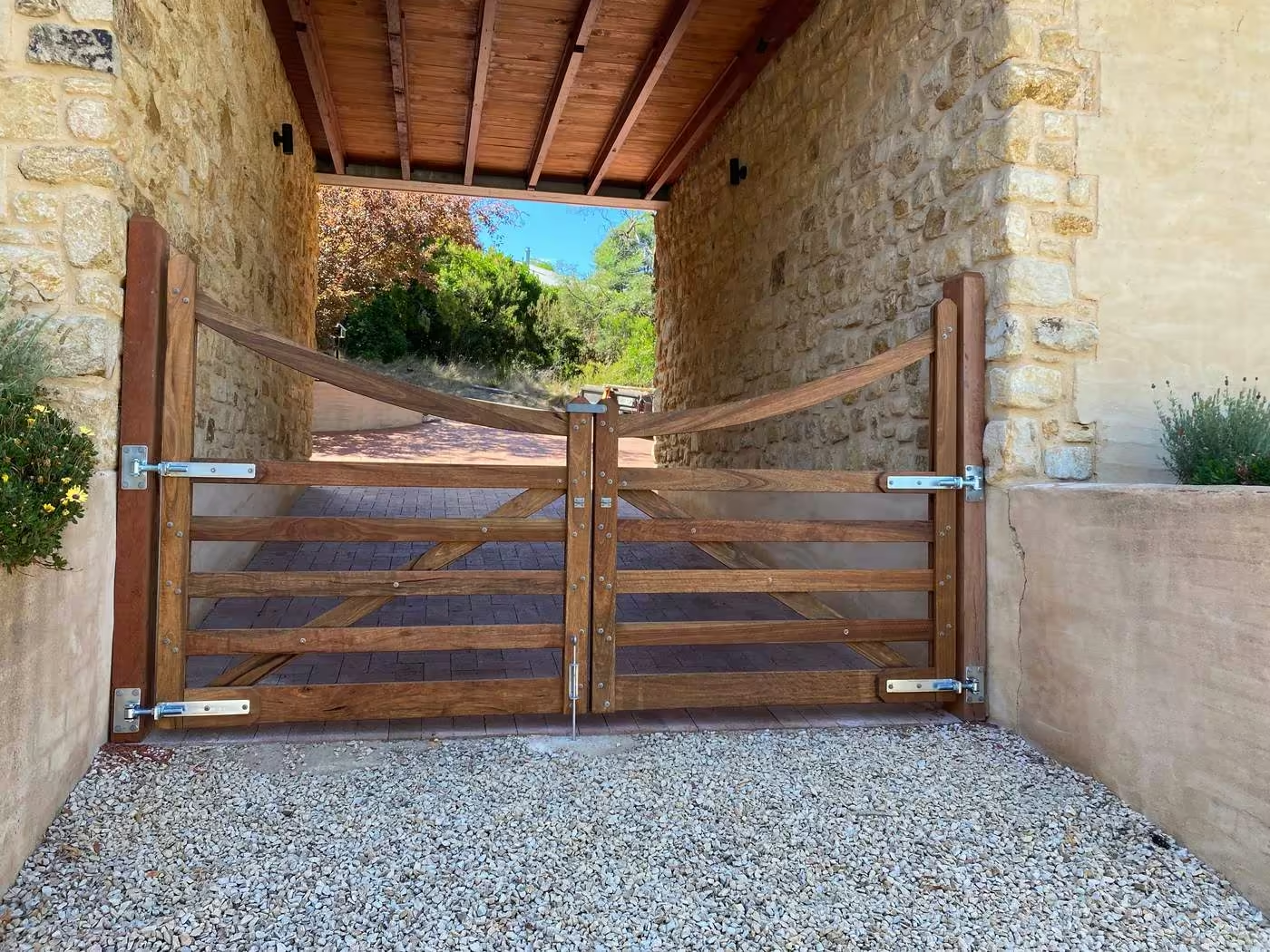
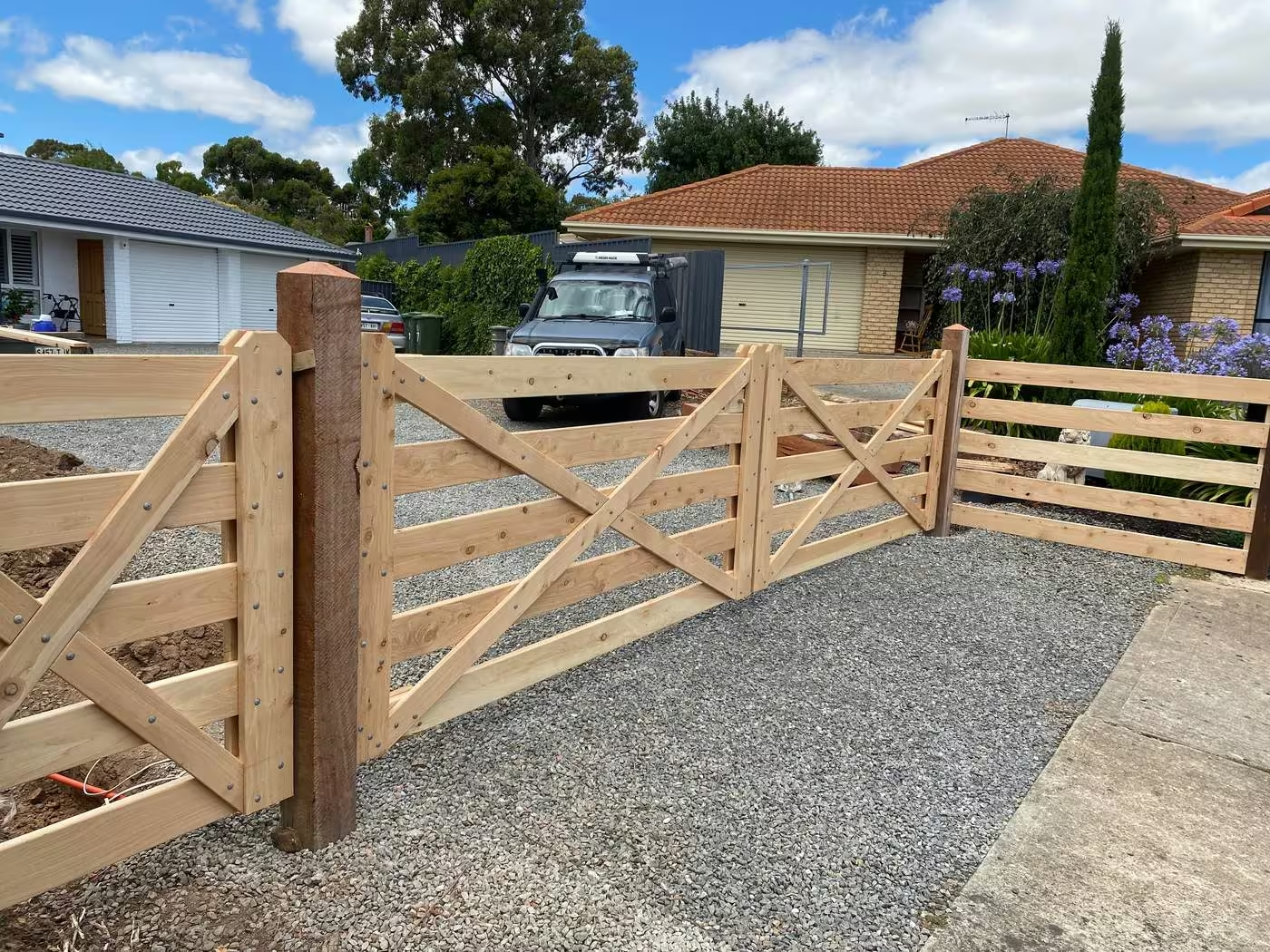
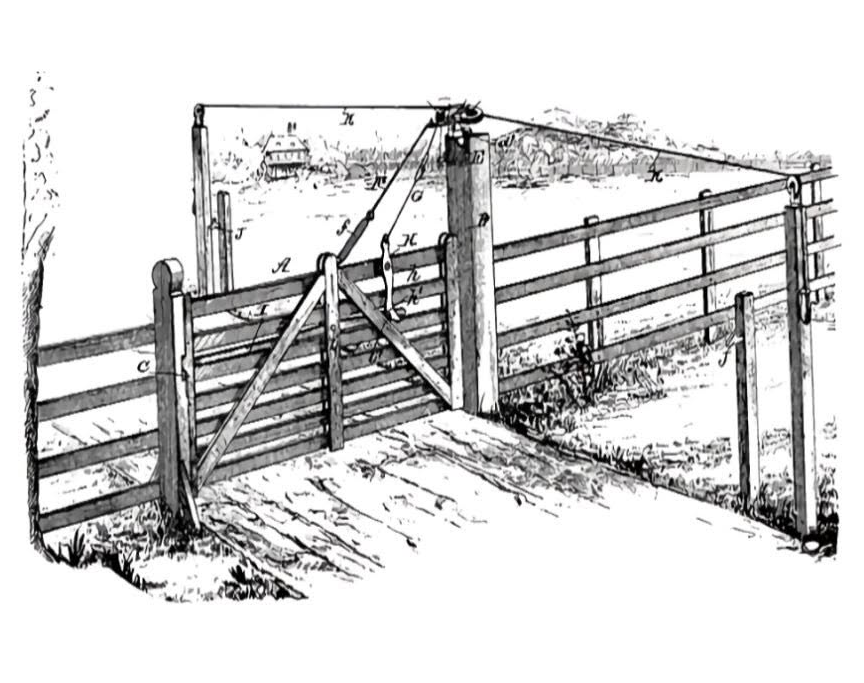
A swing gate hangs on hinges from a post and swings in, either as a single leaf or a pair meeting in the middle. All its weight sits on the hinge post, so the post, its footing and a diagonal brace in the gate do the work.
A sliding gate rolls sideways across the opening and parks beside it, along the fence. A tracked sliding gate runs on wheels along a rail set into the ground. A cantilever sliding gate has no track across the opening: it hangs off rollers on posts beside the opening and carries an extra length of frame behind it to balance the weight, so it needs more room to slide back into.
When a swing gate makes sense
- There is room inside the opening. Each leaf needs clear ground to swing through, roughly its own width, with nothing in the way: no rise in the drive, no garden bed, no parked car.
- The ground is level or falls away from the gate. A gate that swings uphill will hit the ground. A small rise can be allowed for in how the gate is hung, but not a steep one.
- You want the timber look. A pair of braced hardwood gates is the classic farm and homestead entrance, and hardwood is what Neil builds most of his gates from.
- It sits with a cattle grid or stock. A swing gate across a laneway or beside a grid is simple to open by hand when you need to move stock.
When a sliding gate makes sense
- The driveway climbs behind the gate. If the drive rises steeply straight after the opening, swinging leaves would dig into the slope. A sliding gate moves sideways, so the slope does not matter as long as the run-back is level.
- The gate is close to the road. With a swing gate that opens inward, the car has to stop clear of where the leaves swing. A sliding gate lets you pull further in off the road while it opens.
- Space is tight inside the opening. In town driveways, or where the house or shed is close, there may be nowhere for leaves to swing.
- Wind. A big solid leaf on a swing gate acts like a sail on its hinges, and a motor has to fight it. A sliding gate is supported along its length, which helps on an exposed ridge, though a solid infill still catches the wind.
The catch is the run-back. A sliding gate needs a straight, clear stretch beside the opening at least as long as the gate, and more again for a cantilever design. On a block where the fence line beside the gate drops away, turns a corner or runs into trees, that space may not exist.
Tracks on gravel driveways
A tracked sliding gate runs on a rail across the driveway. On a gravel drive, stones, leaves and mud end up in that rail, and the gate jams or the wheels wear. It can be managed with a well-built concrete strip for the track and regular sweeping, or avoided with a cantilever gate that leaves the driveway clear. On most rural gravel entrances, that is worth thinking about early.
If the gate will have a motor
Both types can be automated. A swing gate uses an arm motor on each leaf, mounted on the post, or an underground motor. A sliding gate uses one motor beside the opening driving a toothed rack along the gate. Neil fits swing and sliding gate motors to gates he builds and to gates you already have.
Whatever the type, the gate must move freely by hand before a motor goes on, and the motor has to be rated for the gate's actual weight and length. On a long rural driveway the motor usually runs off a battery and solar panel; our guide to solar gate openers covers sizing it for winter.
Safety around automatic gates
Any automatic gate can trap a person, child or animal. With swing gates, the risk is between the leaf and the post or a wall. With sliding gates, it is where the gate runs back past the post and along the fence. The Australian and New Zealand standard for electric gate drives is AS/NZS 60335.2.103. Safety beams across the opening, correct force settings with auto-reverse, and a manual release you know how to use are worth having on either type, especially with kids, dogs or stock about.
What to work out before you get a quote
- The width of the opening, post to post.
- Whether the driveway is level, rises or falls behind the gate.
- How much clear, level fence line there is beside the opening, on each side.
- Whether there is power near the gate, or it will be solar.
- Who uses it: cars only, or trucks, machinery, horse floats or stock. Our farm gate guide covers widths for machinery.
- A few photos taken from the road and from inside the property.
Neil builds gates to fit the opening and fits the motor to suit, from Angaston across the Barossa Valley, the Adelaide Hills and Gawler. See custom gates.
Common questions
Is a sliding gate better than a swing gate?
Neither is better everywhere. Swing gates suit most rural entrances with room for the leaves to open. Sliding gates suit driveways that climb behind the gate, tight spaces, and gates close to the road, as long as there is a clear run of fence beside the opening.
How much space does a sliding gate need?
A clear, fairly level run beside the opening at least as long as the gate itself, and more for a cantilever gate, which carries an extra length of frame behind it to balance the weight.
Can a sliding gate go on a sloping driveway?
Yes, that is one of the main reasons to choose one. The driveway can rise behind the gate, but the run-back along the fence where the gate parks needs to be level.
Can an existing swing gate be automated?
Usually, yes, as long as it swings freely by hand and the motor is rated for its weight and length. Neil retrofits swing and sliding gate motors.
Want a price for your job? Call Neil on 0447 044 266 or send a photo through the quote form.